
How to Test Garage Door Safety Sensors and Auto-Reverse (Monthly Check)
Your garage door is the largest moving object in your house, and the opener is the only thing deciding when it stops. Two safety features keep it from closing on a person, a pet or a car: the auto-reverse system and a secondary device, usually the pair of photo-eye sensors near the floor. Both can drift out of adjustment without you noticing.
This guide explains what those features are, why the U.S. Consumer Product Safety Commission (CPSC) has long advised testing them monthly, and what a basic check looks like. It's a safety check, not a repair. If the door fails, stop relying on it and have a technician look at it.
What the federal safety rule requires
Federal rules at 16 CFR Part 1211 apply to residential garage door openers made on or after January 1, 1993. Two parts matter here:
- Auto-reverse. A closing door must start to reverse within 2 seconds of contact with an obstruction.
- A secondary safety system. The opener must also have a second form of protection. Most homes have photo-eye sensors mounted a few inches above the floor on each side of the door. The rule also allows an edge sensor on the bottom of the door, or a hold-to-close wall button within sight of the door.
The rule grew out of tragedies. In 1991 the CPSC said it knew of 46 children aged 2 to 14 who died between 1982 and 1990 after being trapped under automatic garage doors, and it advised homeowners to test openers monthly. Nobody inspects your garage for compliance. Keeping the system working is up to the homeowner.
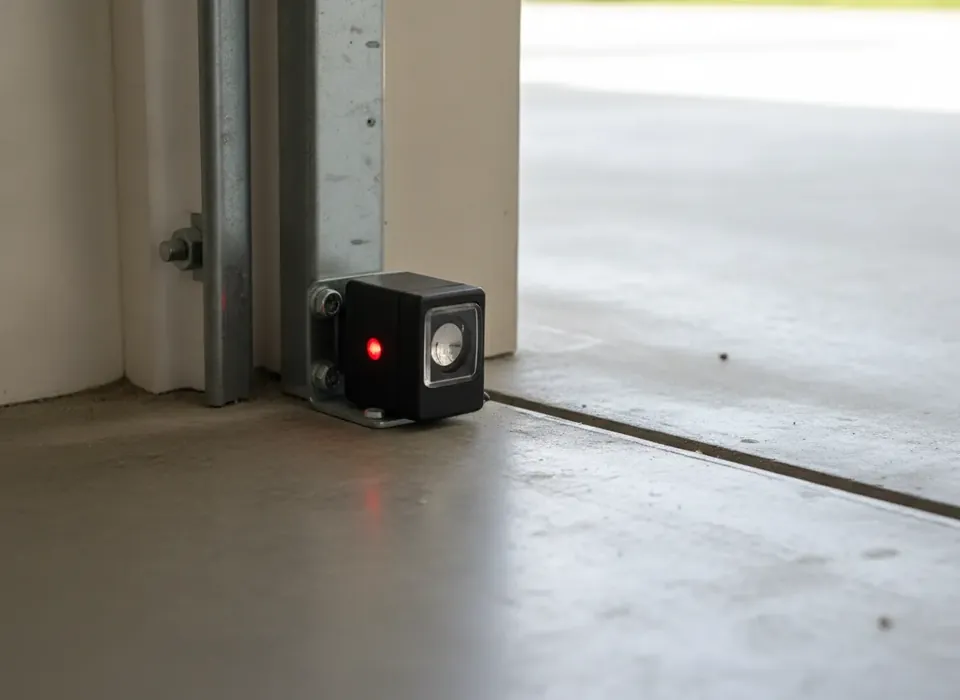
How to test the garage door safety sensors
Your opener's manual describes the exact test for your model, and it's the best source. The general steps below match the kind of check the CPSC and opener makers describe. Keep children, pets and everyone else clear of the door the whole time, and never use your hand, foot or body to test it.
Look first
With the door open, check that both sensors are mounted firmly, their lenses are clean, and nothing is stored in the beam path. Note whether the indicator lights on each sensor are lit as your manual says they should be.
Test the photo eyes
Start closing the door with the remote or wall button. Pass an object, such as a cardboard box or a broom handle, through the beam near the floor. The door should stop and go back up.
Test auto-reverse on contact
Open the door fully. Lay a firm object flat on the floor in the center of the doorway, such as a short piece of 2x4 lumber. Close the door. When it touches the object, it should reverse within about 2 seconds.
Write down the result
Note the date and whether the door passed. A monthly reminder on your phone makes this a two-minute habit.
What a failed test means
| What happened | What it can point to | Next step |
|---|---|---|
| Door won't close at all, opener light blinks | Photo eyes blocked, dirty or knocked out of line | Clear the path and clean the lenses; if it still won't close, have it checked |
| Door closes even with the beam blocked | Sensors bypassed, miswired or not working | Stop using automatic close and call a company |
| Door doesn't reverse on contact | Force or travel settings out of adjustment, or a worn opener | Stop using automatic close and call a company |
| Door feels heavy, jerky or uneven | Possible spring, cable or roller problem, not a sensor issue | Don't adjust anything; have the springs and cables inspected |
Opener adjustments interact with the door's balance, and a door that is out of balance often points to a spring problem. Torsion springs store enough energy to cause serious injury. Leave spring and cable work to a trained technician.
If your door fails the test
Stop using the remote or automatic close until it's fixed, keep kids and pets away from the door, and describe the problem when you request quotes. Some local companies offer evening, weekend or emergency service, often at a higher rate (Fixr: +$100–$300). Mention urgency on your request and ask about after-hours fees.
Why sensors stop working
Most sensor trouble is ordinary wear around the garage: a bracket bumped by a bike or trash can, a cobweb or dust film on the lens, a pinched or chewed low-voltage wire, or bright low sun shining straight into one eye at certain times of year. The garage door safety sensor repair page covers those causes and what a technician usually checks.
Age matters too. Openers made before 1993 were not built to the current rule and may have no photo eyes at all. Published guides put typical opener lifespans at about 10 to 15 years (Fixr, January 2025). Delaware County's median home was built in 2000, and about two-thirds of homes went up between 1990 and 2019 (ACS 2020–2024), so many original openers here are at or past that range. In older neighborhoods such as parts of Westerville and Worthington, or the historic core of Delaware, Ohio, some openers may be older still.
Repair the sensors or replace the opener?
A sensor problem on a newer opener is often a modest repair. Published guides put sensor repair or replacement at about $100 to $150 (Fixr, January 2025), plus any trip fee, which typically runs $50 to $75. If the opener is old, has no secondary safety system, or fails more than one test, replacing it may make more sense. Our opener repair and replacement page and the repair or replace guide walk through that decision. For more ranges, see the garage door repair cost guide.
Ohio's repair estimate rule
For repairs over $25, Ohio rules generally require the company to let you choose a written, oral or no estimate before work starts, and to tell you up front about trip, service-call or diagnostic charges (Ohio Adm. Code 109:4-3-05). Ask for a written estimate and an itemized bill. This is general information, not legal advice. More detail: your repair estimate rights in Ohio.
Add the test to a simple routine
Many homeowners pair the monthly safety test with a quick look and listen: does the door run smoothly, are rollers quiet, is either cable frayed, is there a gap in a torsion spring? Note anything odd and leave the hardware alone. A yearly garage door tune-up from a local company usually includes a balance check, lubrication and a safety test, and cold mornings (the Columbus area averages about 103 nights a year at or below freezing, NOAA 1991–2020 normals) are often when a weak part shows itself.
If your door didn't pass, you can request free quotes from independent local companies, or call (740) 471-1706.
Frequently asked questions
How often should I test my garage door safety sensors?
The CPSC has long advised testing garage door openers monthly. A basic check takes a couple of minutes: pass an object through the photo-eye beam while the door closes, and check that the door reverses when it touches a firm object on the floor. Follow your opener manual for your model.
Why does my garage door go back up when I try to close it?
Usually the photo eyes think something is in the way. A dirty lens, a bumped bracket, an object in the beam or a damaged wire are common causes. If cleaning the lenses and clearing the path doesn't fix it, have a technician check the sensors and wiring rather than bypassing them.
Are garage door safety sensors required by law?
Federal rules (16 CFR 1211) require openers made since January 1, 1993 to reverse within 2 seconds of contact and to have a secondary safety system. Photo eyes are the most common choice, but the rule also allows edge sensors or a hold-to-close control. Older openers may have none.
Can I keep using my door if it fails the reverse test?
It's safest not to rely on automatic closing until it's fixed. Keep children and pets away from the door and have it checked. A door that doesn't reverse can point to opener settings, a worn opener or a balance problem, and balance problems often involve springs that only a trained technician should touch.